
1865: Soldiers from Opsterland during the Battle of Waterloo
In the archives, we find a remarkable letter from 1865 between the Minister of War, Johan Blanken, and the mayor of Opsterland regarding a commemoration of the war years 1813–1815, and in particular the Battle of Waterloo, in which a number of residents of Opsterland had also fought. The plan was to hold this event on June 27, 1865, in Leiden, 50 years after the event took place.

Battle of Waterloo, June 18, 1815.
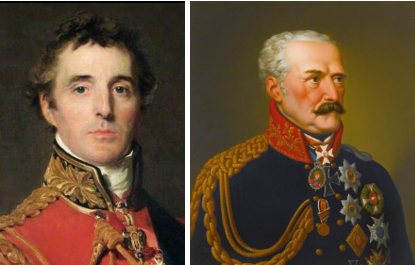
One of the most famous battles in European history is the Battle of Waterloo near Mont-Saint-Jean, which was fought 5 kilometers south of Waterloo in present-day Belgium. Napoleon’s French army faced a coalition of Dutch, British, Hanoverian, and Prussian troops. This allied army was led by the Duke of Wellington, and the Prussian troops were commanded by Field Marshal Blücher.
Napoleon had already been exiled to Elba in 1814, but returned to France in March 1815. There, he crowned himself emperor of France once again. England and Prussia assembled large armies in the Southern Netherlands to invade France. Napoleon decided to preempt them. On June 14, 1815, he crossed the border at Charleroi. He hoped to defeat the armies of Wellington and Blücher. Napoleon’s left wing was held up by the Dutch on June 16, 1815, at the Battle of Quatre-Bras. Approximately 72,000 French soldiers and 68,000 Coalition troops clashed in an 8-hour battle. After several strategic moves, the French army was defeated. Napoleon was exiled to the island of Saint Helena.
Warriors from Opsterland
Veterans from across the country were invited to attend the festive commemoration in Leiden, including several soldiers from Opsterland. A letter in our archives indicates that at least seven veterans were nominated to participate in the commemoration, which the government intended to organize. The individuals in question were:
- Klaas Tjeerds Bakker (1796–1870) Kortezwaag
- Sijtze Roels Krist/Crist (1793–1871) Luxwoude
- Geert Oenes Dolstra (1793–1887) Luxwoude
- Juda Arons Cohen (1796–1881) Gorredijk
- Hijlke Sijtzes Annema (1795–1868) Lippenhuizen
- Kornelis Jans Koolstra (d. 1865) Langezwaag
- Rein Heins van der Vliet (1793–1881) Terwispel
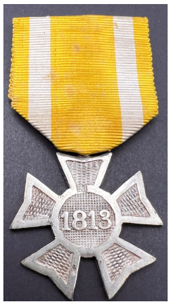
The former military personnel viewed the king’s decision to award a “medal of honor” with a “sense of gratitude.” This medal of honor was awarded to them for their military efforts to restore and affirm the Netherlands’ independent “national existence,” in which they played a “significant” (important) role. The medal of honor was an official Silver Commemorative Cross 1813–1815. To ensure no one was left out, no distinction was made based on rank or social status. All soldiers who served during the period from the Battle of Leipzig on October 16–19, 1813, through the Battle of Waterloo on June 18, 1815, were eligible for the medal of honor.
Requirements
To participate in the commemoration, certain Requirements applied: participants had to cover their own travel expenses, and they were only allowed to attend if they had continued to demonstrate “good civic behavior” after their military service. Their moral character and conduct had to be thoroughly verified. Although the veterans were eager to attend the commemoration, they faced several practical challenges. Traveling to Leiden entailed considerable expense. These costs included the stagecoach, the train, and the boat needed to reach Leiden. As a result, registrations were slow to get underway at first, but then the Dutch began offering assistance to help people make the trip to Leiden. The railroad companies transported the veterans free of charge from Amsterdam and Rotterdam to Leiden, and people in Leiden offered them free lodging. However, they had to pay for the portion of the journey to Amsterdam and Rotterdam themselves. It is unclear which veterans ultimately participated in the festivities. We do gather from the correspondence, however, that Juda Arons Cohen managed to scrape together the necessary funds through various channels.
Commemoration Day: June 27, 1865, a commemorative celebration of national significance
The day before, trains from Rotterdam and Amsterdam arrived in Leiden at 6:00 p.m. Veterans were waving from every train window. A loud cannon blast rang out as a welcome, which also marked the opening of the commemoration. The mayor and several other dignitaries welcomed them, along with an honor guard of infantry and artillery and the “Leiden Militia Band.” In the garden and large rooms of the “Zomerzorg” station café, owned by pastry chef Jacob Couvée, they were able to rest from their journey while enjoying a drink. They received a personalized admission card as their ticket to the festivities that had been organized. As a preview, a festive parade was also held through the city that evening.
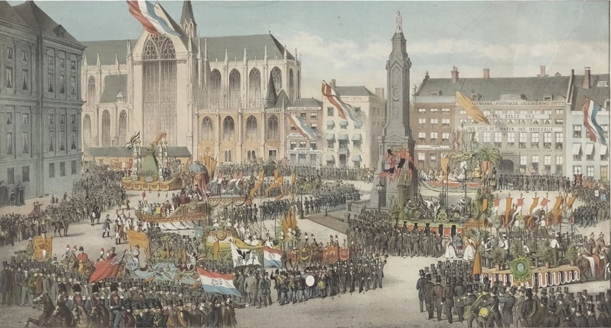
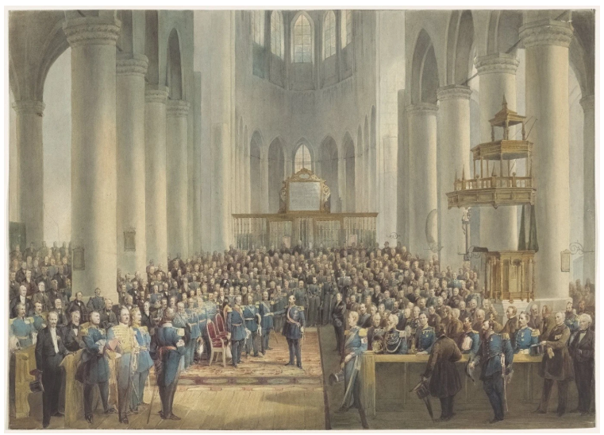
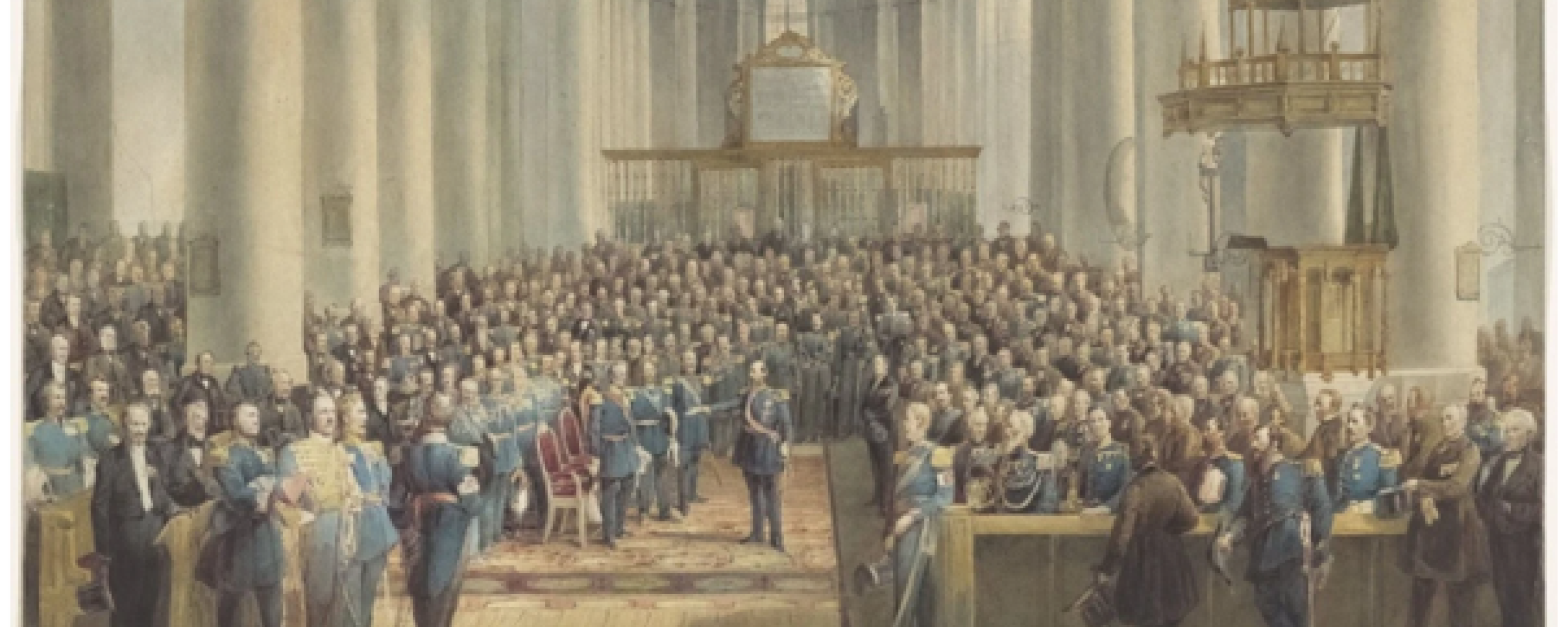
The next morning at 8:00 a.m., the veterans were to be ready again. Once more, the cannons boomed and the carillon rang out. At 10:00 a.m., they were to assemble at the Invalidenhuis. Accompanied by a military honor guard and music, they set off for the “Grote Ruïne,” an open space left behind as the remnant of a major gunpowder disaster (on January 12, 1807, a ship carrying 18,000 kilograms of gunpowder had exploded, wiping out a residential neighborhood and leaving behind an open space). The streets were decorated; many former soldiers arrived in decorated carriages, and some carried banners. Around 11:00, a carriage arrived carrying Prince Frederick of the Netherlands, uncle of the then-reigning King William III. He was at that time the most beloved and immensely popular member of the House of Orange, himself a veteran of the years 1813–1815. He mingled with the veterans. The group proceeded to St. Peter’s Church for the solemn gathering. At 1:00 p.m., a carriage arrived there carrying King William III and his sons, Crown Prince William and Prince Henry. A speech was delivered in St. Peter’s Church, and the silver commemorative crosses were pinned on the veterans. This was followed by a final procession. They were cheered on by a large number of residents. Flags, pennants, and banners fluttered everywhere, and flowers were scattered along the route. Afterward, a grand banquet was held. For many veterans—many of whom had lived in poverty—this experience must have been overwhelming. Accompanied by the cheerful music of a military band, the guests were invited to choose their own seats at one of the long tables decorated with flowers. On each plate lay a printed menu for the seven-course dinner. This marked the end of the official festivities. In the evening, a grand public celebration was held in the city. Musical performances, skits, magic acts, and acrobatic shows took place everywhere. String lights and gas lamps created a festive atmosphere.
About the Veterans
Many of the veterans led a meager existence. But who were they, and what else did they do? We can find out a little more about some individuals than others. It is clear, however, that most of them earned their living as laborers, which explains why they had trouble covering their travel expenses. Klaas Tjeerds Bakker, born in 1796, came from a well-to-do family. However, for financial reasons, he had to abandon his medical studies. Klaas was a freethinker and worked as a “domestic peddler” and merchant. On April 10, 1817, he married Tjitske Ebes Blauw, who, like him, was from Kortezwaag. She died in 1840 at the age of 41. He later married Fokjen Rinderts van Zinderen. They were the parents of Rindert van Zinderen Bakker (1845–1927), a Frisian socialist politician and Frisian writer.
Geert Oenes Dolstra was one of the last Waterloo veterans to pass away; he was 94 years old. Dolstra had led an eventful life. He survived a shipwreck when he was 9 years old. He traveled to Greenland, Russia, and America. During the Battle of Waterloo, he sustained five wounds. He also took part in the Ten Days’ Campaign, where he fought against rebellious Belgians. He continued to work as a barber well into his old age. Although a 1887 newspaper article reported that he was living in poverty, this was met with a response stating that it was completely untrue. In his final years, he was supported by a committee that raised money for his living expenses. For example, people could buy a photograph of his portrait for one guilder.
Sijtze Roels/Roelofs Krist was born in Terwispel or De Knijpe. The sources are not entirely clear on this point. He was a peat worker and married Saapke Gosses Heideman/van der Heide on February 17, 1820. No further information about him is known. Juda/Levie Arons Cohen/Kats was born in Gorredijk in 1796. He married Henriette Nathans Magnus. He died in 1881 and is buried in the Jewish cemetery near Kortezwaag. Little information is available about him either. Hylke Sytzes Annema from Lippenhuizen married Janke Wybes Plantinga from Langezwaag on April 15, 1819. He was a laborer. Kornelis Jans Koolstra from Langezwaag was also a laborer. He married Ypkjen Jans de Jong from Nieuwehorne in 1820. Rein Heins van der Vliet was originally from Leeuwarden. He was baptized there on September 29, 1793. By 1811, the family was already living in Opsterland. On August 20, 1818, he married Trijntje Hendriks Penninga. He, too, was a laborer. It is noteworthy that the letter refers to “Hein Reins van der Vliet.” However, this information does not appear to be accurate. Rein did, however, have a son by that name.
Download the letters to the veterans below: