1760: The Voorwerk in Siegerswoude
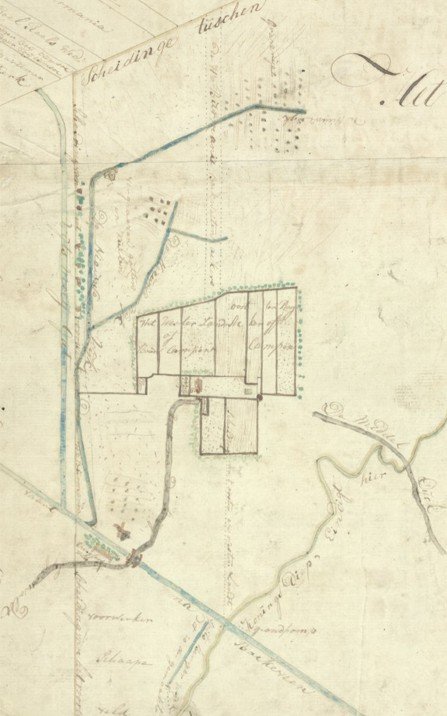
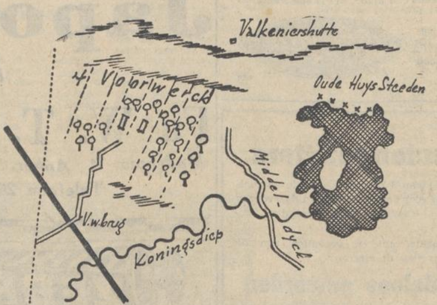
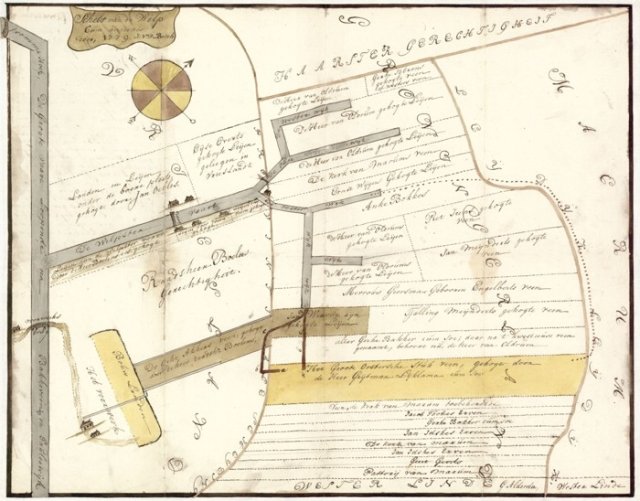
This “Treasure from the Archives” features a map from 1760 depicting a special place in Siegerswoude, which we still know by the same name as centuries ago: Het Voorwerk (It Foarwurk). The origins of Het Voorwerk lie in monastic holdings. In the Middle Ages, it wasn’t just private individuals who owned land; monasteries also held extensive properties and land.

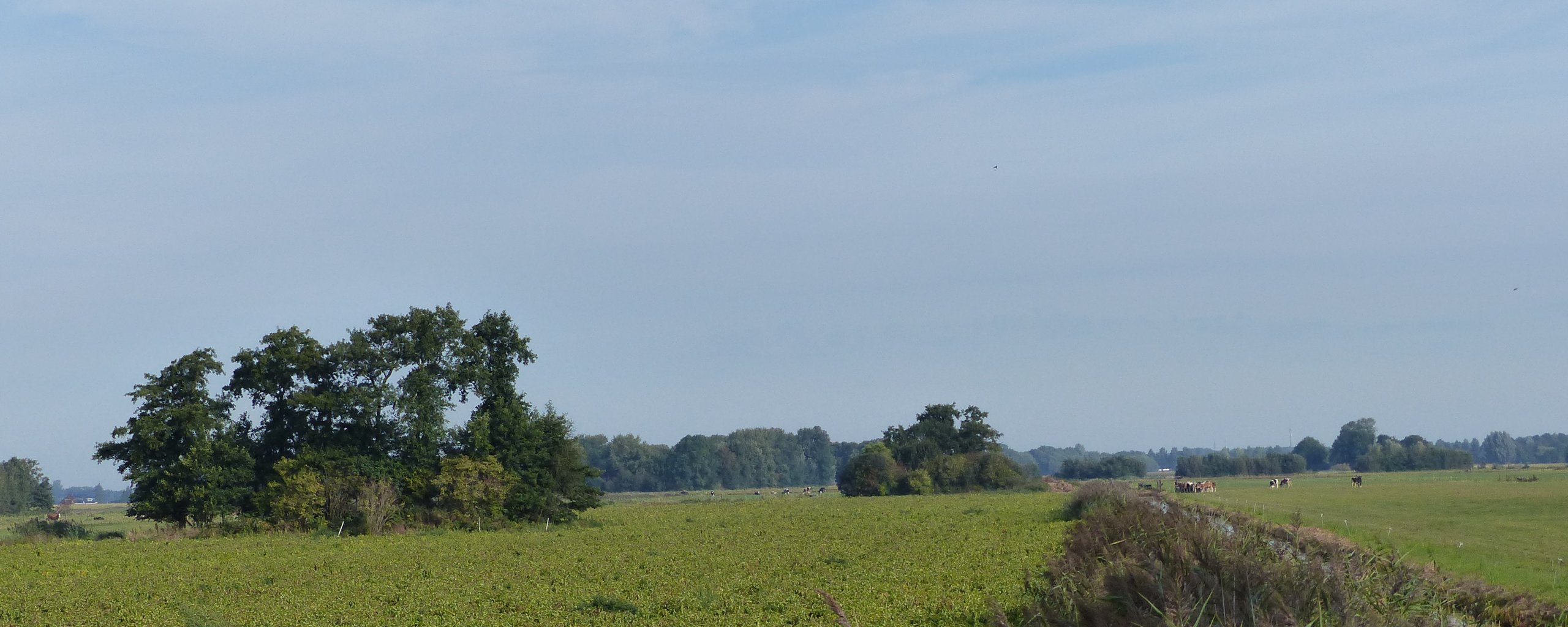
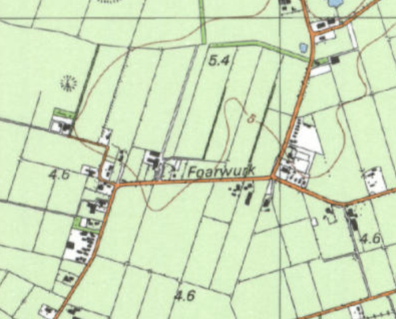
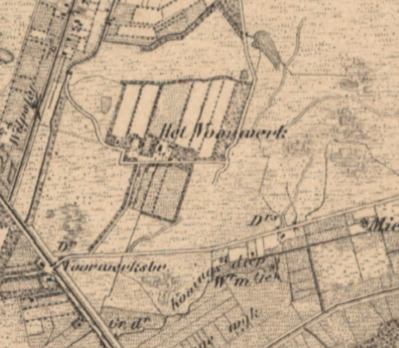
To the east of Siegerswoude lay an outlying estate belonging to the Benedictine monastery of Smelne in Smalle Ee. Among other properties, this women’s monastery owned the Voorwerkerveld. An outlying farm is an abbey or monastery farm. If you drive from Siegerswoude to De Wilp and cross the bridge over the Bakkeveenster Vaart, you’ll see a farm a little further to the northeast that was formerly known as It Foarwurk and Uithof.
Origins
The Voorwerk was likely founded before 1400, when the Smalle Ee monastery was still an Augustinian monastery. The outlying farmstead was situated on a raised ridge in the landscape. Records show that around 1500, a man named Sypke was in charge of the outlying farmstead. In 1518, the Voorwerk was first mentioned in a regulation concerning the drainage of the “uijthoeve tot Sijgerswold.” It is also mentioned in 1530, with reference to “Brother Leffert.”
At that time, the surrounding area was still a vast high moor. The settlement farm was surrounded by earthen embankments and trees. Next to the house was an “ikenhiem” (oak grove), an area planted with oak trees, from which wood was harvested for carpentry. Next to the main house stood a small outbuilding, a “Drintehok,” which served as a pen for the flock of Drenthe sheep. These sheep were kept there until the nineteenth century, when the heathland was cleared around 1900.
Life on It Foarwurk
At the Voorwerk, nuns worked alongside lay brothers. They harvested hay and grew oats, reeds, beans, and peas. Their main activity was herding sheep. They also kept other livestock, including oxen, horses, and cows. Dried meat, sheep and cow cheese, butter, and honey were transported to the monastery. Hunting also yielded hares, deer, and game birds. Sheep’s wool was important for spinning and weaving yarn at the monastery. Often, the tenants were also required to pay a leasehold fee. During the Eighty Years’ War, in October 1572, the outlying estate was plundered by the Watergeuzen, who were rampaging through Friesland.
Changing Ownership
In 1580, all the monastic estates in Smalle Ee passed into the hands of the States of Friesland after they banned the Roman Catholic faith. The monastery in Smalle Ee had already been demolished by 1581. All that remained in Siegerswoude was a monastery farm with its associated lands, which was inhabited by a tenant farmer named Luytzen Hendrickx. The rent consisted of oats and ten sheep per year. In 1640, Alle Foeke Hendrix was the tenant. In 1644, the Voorwerk and its associated farmlands—totaling 503 hectares—were sold by the States of Friesland for 4,500 gold guilders to Menso Gabbema, a lawyer from Leeuwarden. Not long after that, several investors acquired 25% of the property, including Jacobus Sybrandi Mancadan, a council member and, for a time, mayor of Franeker. He invested in peat extraction. Starting around the second half of the seventeenth century, peat was extracted at the Voorwerk. For this reason, several districts were established.
Mancadan and his wife had three children. Their daughter Ebeltje married Broer Boelardus Boelens, who was, among other things, a surveyor. After Mancadan’s death, the Voorwerk passed into the hands of their daughter Ebeltje, and thus became the property of the Van Boelens family. The Voorwerk remained in the possession of families descended from Boelens until 1843
-Mancadan, such as the Wigeri family, the Van Harinxma family, Rijnhard Baron van Lynden, and Frans Godard Ayzo van Boelen. However, they did not live there themselves; instead, the property was leased to others.
The tenants and the origin of the surname Uithof
In 1843, the Voorwerk and all its associated properties were seized by the Ministry of Justice, possibly as a result of bankruptcy. It came into the possession of tenant farmer Roel Hendriks. His ancestors had already been living on the farm for many years. A Heyne Roelofs had been living on the farm even before 1685. In 1728 and 1798, a Heine Roels lived on the farm as a tenant on both occasions, and in between, a Roel Heines. Roel Heines was a farmer at the outlying farmstead in 1778 and 1788. In 1811, Roel Hendriks lived at the Voorwerk. Roel, along with his brothers Boke and Jacob Hendriks, adopted the surname Uithof. The last Uithof to live at the Voorwerk was Roel Hendriks Uithof, who married Wietske van der Berg in 1880. After that, other families came to live on the farm.
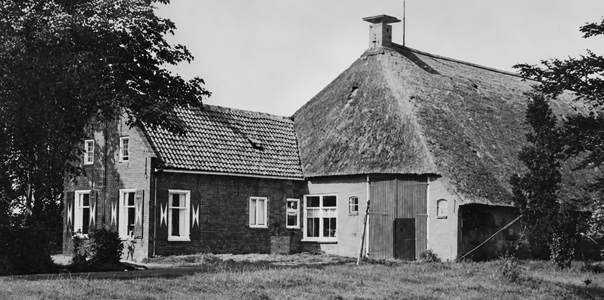
The farm that stands there today is not the original one. At least two earlier farms once stood on the site. A photograph of the farm that preceded the current one appeared in the Leekster Courant. The wall anchors indicate that this farm was built or restored in 1798.
Archaeological Research
In 1984 and 1985, field research was conducted on the Siegerswoude outlying settlement with a grant from the municipality. The research was carried out by the Archaeological Working Group for the Netherlands under the direction of provincial archaeologist Gerrit Elzinga. The then-owner, Gosling Land, was personally very interested in history and had found pottery shards, iron slag, a millstone, and monastery bricks while plowing. Land consolidation revealed old ditches and pits. During the archaeological excavations, remains of canals, waste pits, wells, a possible clay pit, and a 14th-century iron smelter were discovered. Shards of bullet pots, drinking jugs, bowls, and Siegburg pottery were also found. Guided tours were also conducted on the site.