
1961: De Paapsche Leer, a house with a special name
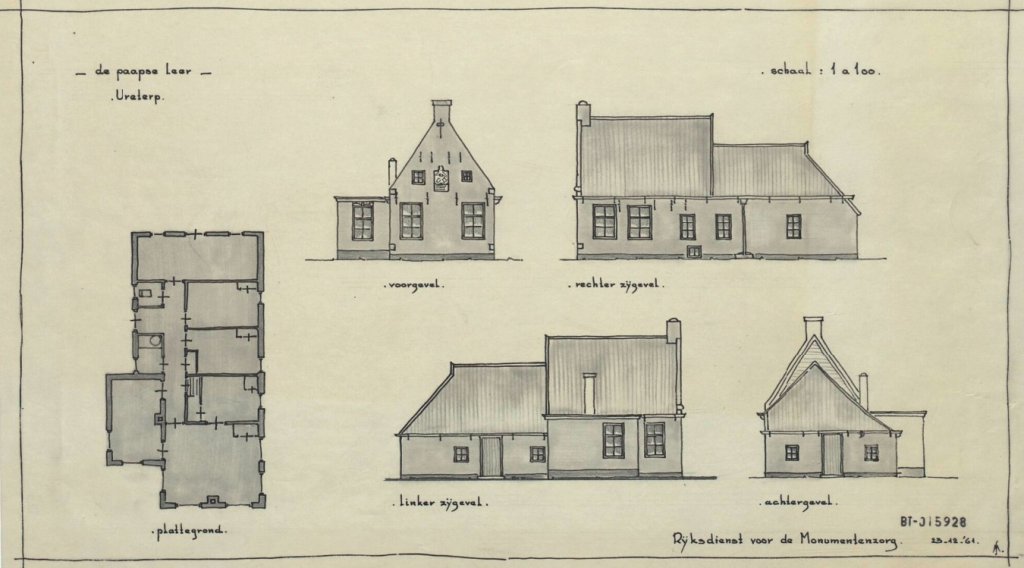
This time, the 'treasure from the archives' concerns drawings made in 1961 by the 'Rijksdienst voor Monumentenzorg' (National Service for Monument Conservation) of a special building and its history. Paapsche Leer, also known as Paapse Leere, Paepsche Leere, or Paapse Leer, was located in Ureterp on the south side of Vaart 2, near the Ureterper Verlaat, between the Paapsche Leerewijk and the Haukewijk. Older Maps around 1800 indicate the location as 'Roomsche Leer'. The house included a piece of pasture land called the 'Paapsche Leere-kamp'. The name still appeals to the imagination. The building was well known in the wider area.

Construction history
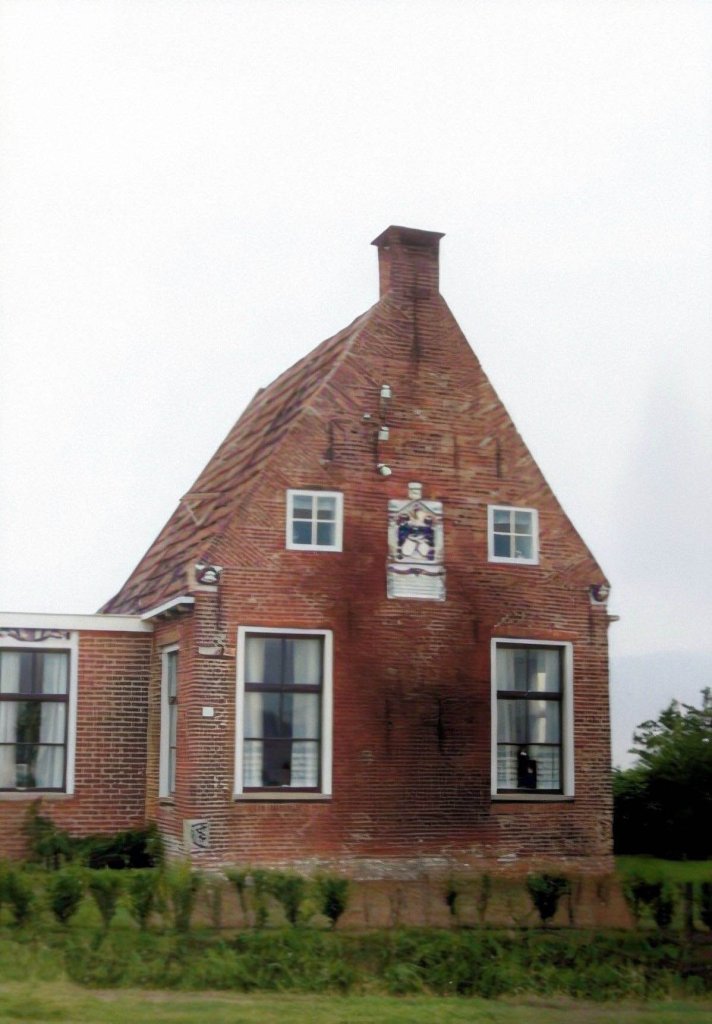
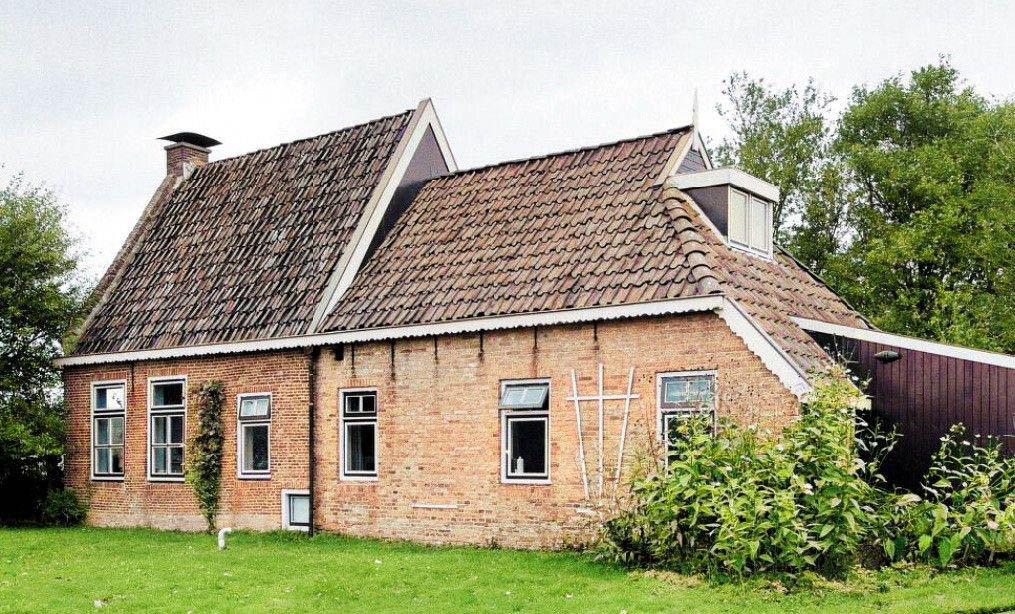
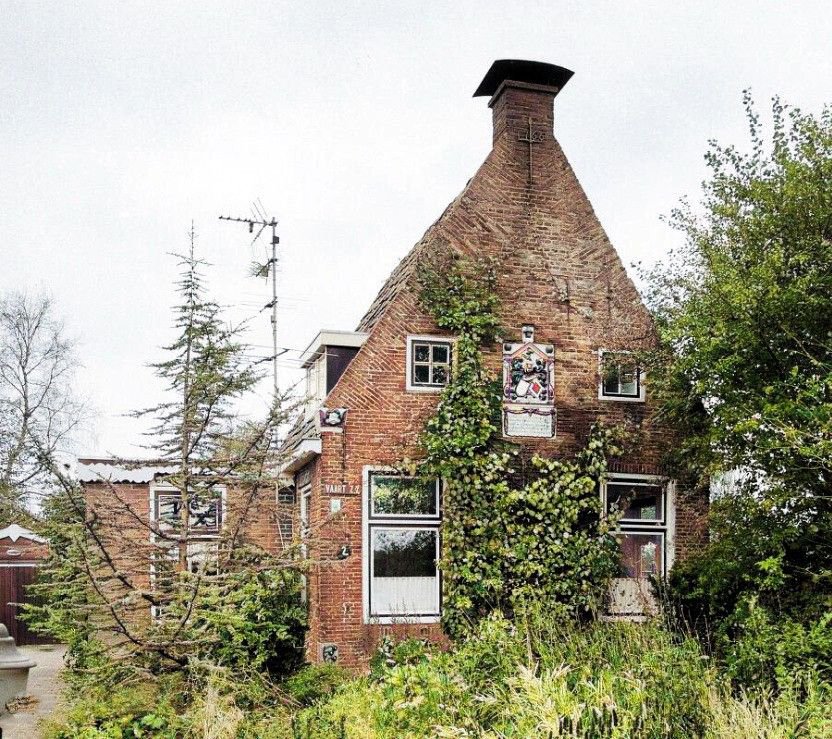
The workers' house was built in 1766, according to the wall anchors on the front facade in the chimney. The building consisted of one story with a gable roof. A special detail in the architecture of the house were the sandstone angel heads in bas-relief on the corners of the facade. The flat extension was decorated with a carved door panel, featuring a squirrel with a few twigs. The front of the house was covered with hollow, glazed tiles and the gable had farmhouse wattlework. The extension dated from a later period, the 1920s, as can be seen from the type of brick used, Groningen red. In any case, this part had already been added before 1927, when Jan Planting made a drawing of the house. The walls of the building itself also consisted of various types of brick dating from after 1766.
The facade stone
Another special feature of the house was the facade stone, which was older than the house itself. The facade stone measured 50 x 80 cm. It contained a Latin text and coats of arms of the noble families Emingha and Van Roorda. The coat of arms depicted a woman's head and a branch with three apples. The family coats of arms had been carved out, probably during the French period.
The translation of the Latin text is as follows:
This gate, which Parchia van Roorda, widow of the noble Pibo van Emegha, began building in 1630 after the first stone was laid by the young Pibo van Aggama, a grandson of the aforementioned Roorda, has recently been erected and completed in this form.
The facade stone from 1639 may have come from the gatehouse of the Roorda family's castle, the Roordaburg in Franeker, and was later built into the wall. Pybe van Eminga (van Schingen) was a son of Syds van Eminga and Catharina van Roorda. He died on January 10, 1611. He was married to Perck (referred to above as Parchia) van Roorda, daughter of Sybrant van Roorda and Teth van Goslinga. In 1636, she lived as a widow at the Roordaburg near Franeker and died on August 18, 1643. At that time, she owned several stinzen, including the Rintjema State in Oostrum and the stins 'oppa Dyck', also known as the Grote Flaren, in Tzum.
After the Reformation, Roordaburg served as a clandestine church for Roman Catholics in the Franeker region who remained faithful to their religion. Perck van Roorda was a member of the Brotherhood of the Holy Rosary in Leeuwarden, a Catholic society dating back to the Middle Ages. It is likely that the Catholic Perck van Eminga-van Roorda and her mother Teth van Roorda-van Goslinga Health the clandestine church at their Roordaburg castle between 1580 and 1640. In the 1832 voting registers, the Van Eminga family is also listed as 'papist', which was Perck's family who lived at the 'oppa Dyck' castle at the time. This also shows that this family remained faithful to Roman Catholic doctrine throughout the centuries.
How did the plaque end up in Ureterp?
How the facade stone found its way to Ureterp aan de Vaart remains a mystery. The story goes that a skipper who transported terpaarde brought the facade stone with him. The Paapse Leer itself was not a gate or gatehouse. Another source states that the stone had decorated a gate of a mansion or castle in Siegerswoude. The carved transom above the window in the newly built section is also said to have come from Siegerswoude. No traces of a castle or mansion in Siegerswoude have been found to date.
Faithful to the faith
Many legends circulated about the house itself. Its name gave rise to many stories. It is unlikely that the disappearance of monastic life in Smallingerland and Opsterland also marked the end of Catholicism. On the largely disappeared old road between Smalle Ee via Drachten to Ureterp, there is said to have been a chapel dedicated to Saint Boniface until the nineteenth century. It is said that this was on the site of this house. Boniface was one of the most important Anglo-Saxon missionaries and church reformers in the Frankish Empire. Only a few residents of Drachten knew where this place was, and according to tradition, believers who remained loyal to the Catholic Church continued to worship in the small farmhouse on the Ureterper-Verlaat, the Paapsche Leer, for a long time. Perhaps a 'small Roman Catholic Gideon gang' gathered at this place during the Reformation; two chaplains are also said to have lived there. The house probably once served as a chapel for the Friars Minor, who held religious services there for those who remained loyal to the Roman Catholic Church when the church was closed, or there was a chapel on this site. It is known that the Van Roorda and Emingha families did not join the Reformation and that around 1640 there were still a few papists living in Ureterp and the surrounding area. Between 1800 and 1900, the building served as a small school for 12 pupils, according to the story.
Demolition
Shortly after 1945, the building was in a state of neglect. In 1962, funds were made available for its restoration. Window frames were replaced, the roof was repaired and reinforced, and completely new foundations were laid. Over the years, many alterations had been made to the building. The front façade, which had remained the most authentic, was completely warped. To keep the gable upright, a new chimney was built in the front room. In 1995 or 1996, the building was demolished in connection with the junction of the Wâldwei and the A7 motorway, despite its status as a national monument. The cloverleaf that now stands there was built on top of the location of the building. After the demolition, the facade stone and the angel heads became the property of the Opsterland Museum.
Images