
1902: Notice regarding thefts in Lippenhuizen
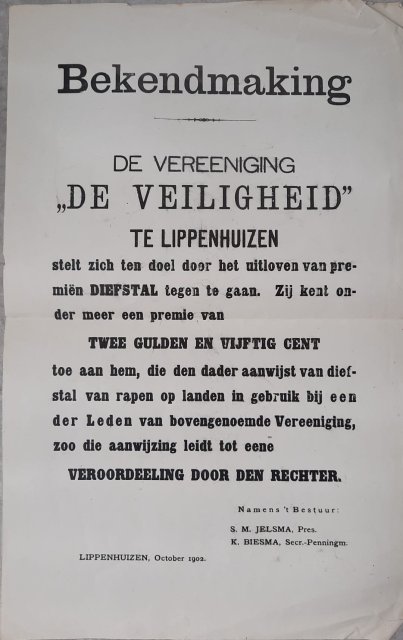
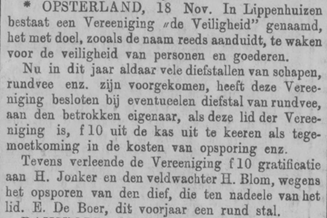
The archival document in the spotlight this time is a public notice from 1902. Over a century ago, workers and day laborers typically lived in poor conditions. It was a time of economic decline, and more than half of the working men were day laborers and workers, who often lacked a stable income. This led to frequent incidents of theft. To address this issue, the “De Veiligheid” Association was founded in Lippenhuizen; its full name was “Association for the Prevention and Detection of Theft in Lippenhuizen.” This association existed from 1871 until approximately 1918.

A large number of members and assets
The association was likely a form of mutual insurance against theft, particularly of livestock, beehives, and other items commonly found on farms, such as wood. The association’s bylaws indicate that its aim was to prevent theft. In the nineteenth century, more than 50 residents of Lippenhuizen were members of the association. In November 1885, the members collectively owned 62 horses, 255 sheep, 421 head of cattle, 220 pigs, and 70 beehives. By May 1886, these numbers had risen to 161 sheep, 171 pigs, 85 beehives, and 16 goats.
Premiums for theft insurance
In an announcement in October 1902, the association also informed residents of its mission. Its goal was to combat theft by offering rewards. Theft was one of the many types of crimes that occurred in the late nineteenth and early twentieth centuries. This was often caused by extreme poverty, alcohol abuse, or insanity. Theft typically involved foodstuffs or peat, but also live livestock, such as cattle, sheep, lambs, and domestic ducks. Poaching was also common. The thieves often came from surrounding villages. The *Dagblad van Zuidholland en ’s Gravenhage* reported that in 1891, there were many thefts of sheep, cattle, and other livestock. For this reason, the association had to ensure the safety of people and property.
For residents only
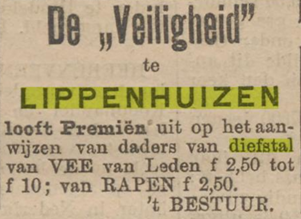
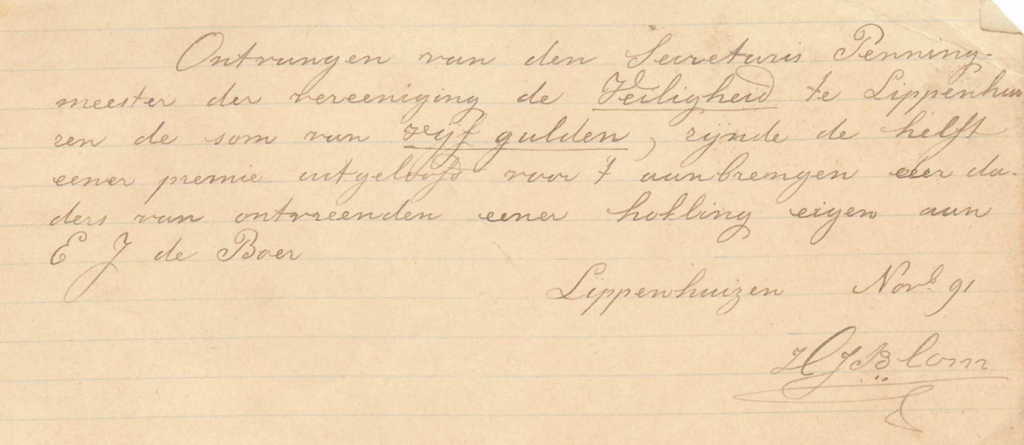
One requirement for membership in the association was that you lived in Lippenhuizen. A reward was offered to anyone who reported an incident to the association, thereby enabling the perpetrator to be prosecuted. Anyone who caught a perpetrator in the act of stealing on land used by a member of the association was entitled to a reward of 2.50 guilders. And the perpetrator would then face a conviction by the court. These amounts were set forth in a set of regulations.
Reimbursements
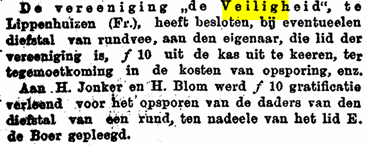
Members could receive compensation from the association’s funds if they were victims of theft, so that the costs of tracking down the thief and the loss itself were (somewhat) covered. If the perpetrators of a theft were tracked down and convicted by a judge, the owner of the stolen property—who also had to be a member of the association—was compensated for the costs and damages incurred. For cattle or horses, the maximum compensation was 10 guilders; for sheep, goats, and pigs, 5 guilders; and for lambs born before October, 2.50 guilders. The victim had to provide a detailed account of what had been stolen and of the expenses, on which the compensation was based. In cases of theft where it turned out that multiple thefts had been committed simultaneously as part of a raid, this was considered a single theft, and only one reward was granted.
A reward was paid to a tipster only if the facts had been proven in court and the tip had led to that evidence. If multiple people provided information, only the person who contributed the most to the apprehension of a thief received the reward. Only if it later turned out that someone else’s tip contributed more to a conviction would that person also receive a reward. If there were multiple informants who all contributed to a conviction, they had to share the reward. If they could not agree among themselves on how to divide the reward, the association would decide during a meeting who would receive which portion. Informants were also assured of confidentiality, at least for as long as the legal proceedings of the case permitted. Members were required to inform the association of the number of cattle and whether they were grazing in pastures within or outside Lippenhuizen.
Organization
The association held two general meetings each year, on the last Saturday of May and November. The board was authorized to organize additional meetings if necessary. The association was governed by seven members, including one president and one secretary-treasurer. Every year at the November meeting, two members were required to step down. The oldest of the two board members who had served the longest was the president. The secretary-treasurer was required to step down every three years but was eligible for reelection.
The courts in Leeuwarden and Heerenveen regularly heard cases involving the theft of livestock. Many people who were arrested for begging or vagrancy were detained and sent to the Veenhuizen penal institutions. They often came into contact with the justice system on multiple occasions.
articles from the newspaper archive