1868: Exhibition in Beetsterzwaag
Step back in time to 19th-century Beetsterzwaag! A time of exciting trotting races for gold watches, spectacular fireworks above the Lyndenbos forest, and parties until sunrise. Discover the spectacular story behind the 1868 exhibition.

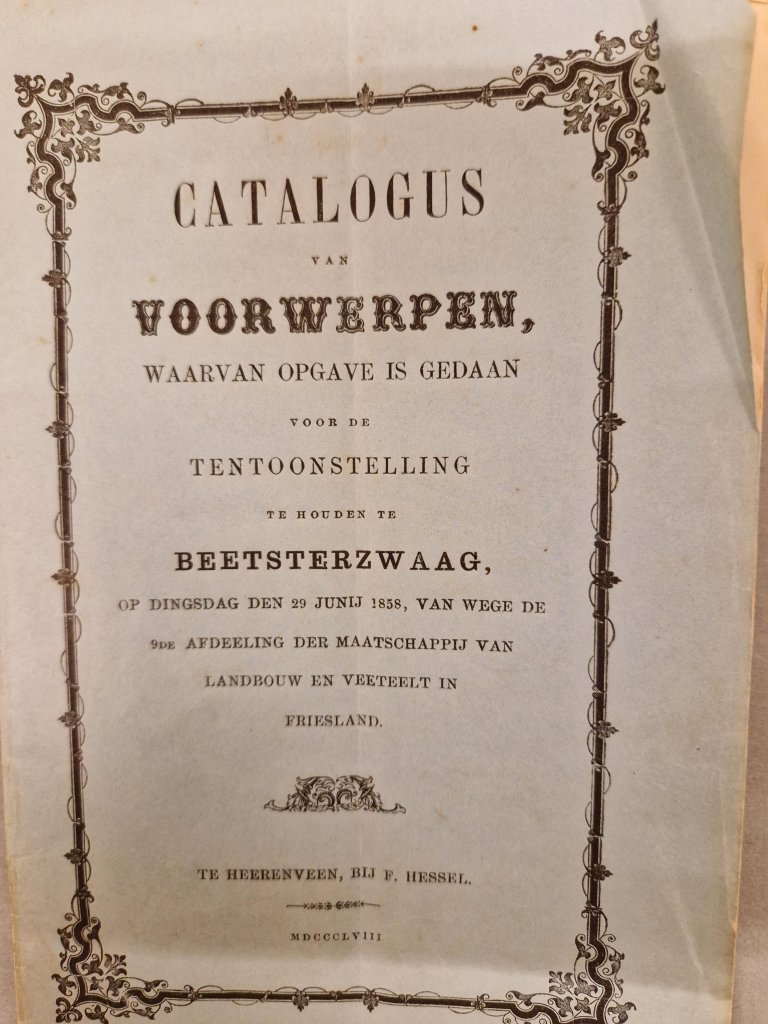
In the archives, we found a catalog from 1858 that accompanied an exhibition held that same year. In 1858, 1865, and 1868, exhibitions on "agriculture and livestock farming" were organized in Beetsterzwaag. In 1858, this day was celebrated in style, with trotting races where prizes such as gold or silver watches could be won. During the 1865 exhibition, people from all over stayed in Beetsterzwaag all night long, until the crack of dawn. Beautiful fireworks were set off and the Lyndenbos was magnificently illuminated. The 1868 exhibition was to be at least as grand as the previous exhibitions.
The initiative for the 1868 exhibition came from the Association for the Improvement of the Horse Breed. The committee of this association consisted of Mr. R. Taekema from Ureterp, chairman of the association, K.W. Rinsema, and A. Baron Van Harinxma thoe Slooten, who was treasurer. They wanted to exhibit the stallion Radboud and his offspring. The association itself owned the black stallion. Chairman Taekema had purchased Radboud from H. Hoiting, a farmer in Bronniger, Drenthe. The stallion was available for stud service at the farm of Oene Fokkes de Boer in Olterterp. The idea arose to combine a larger exhibition with the showing of Radboud, where agriculture and livestock breeding could be viewed in miniature. To make this possible, the 9th Division of the Frisian Society for Agriculture and Livestock Breeding was also involved in the exhibition.
Announcement of the program
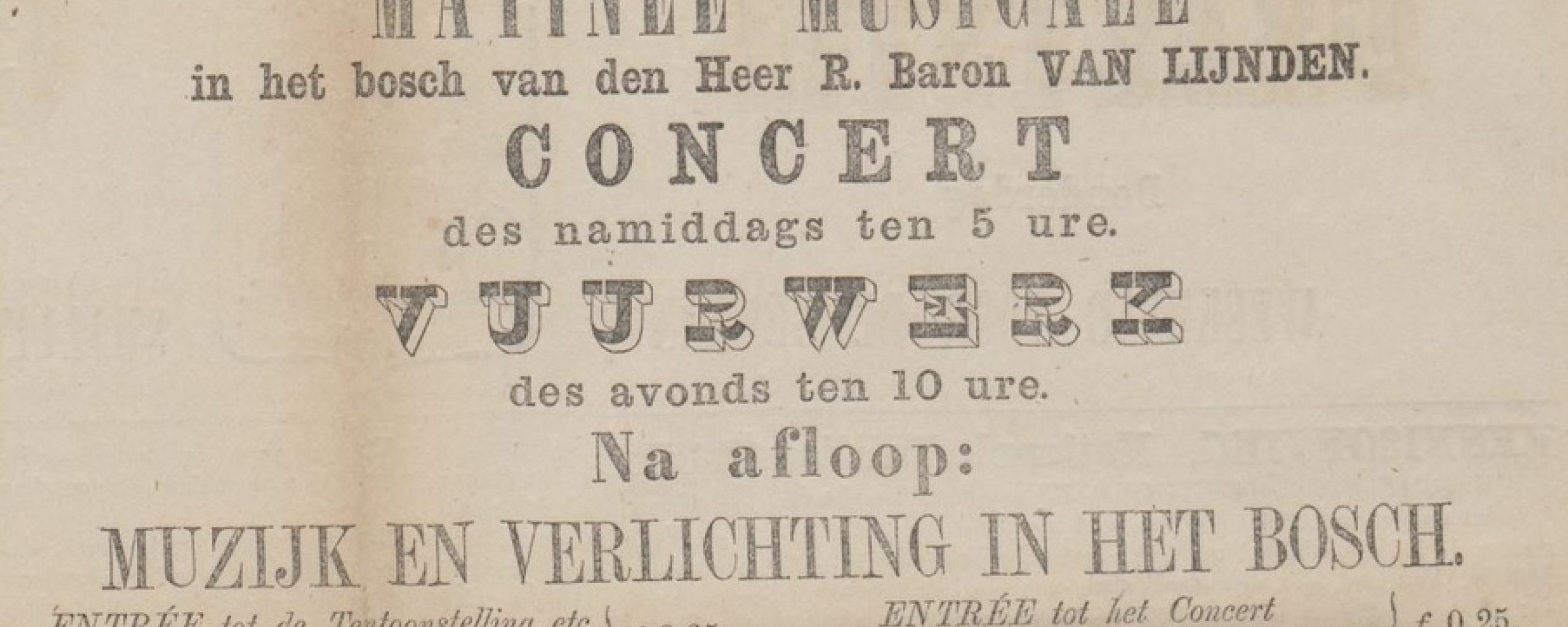
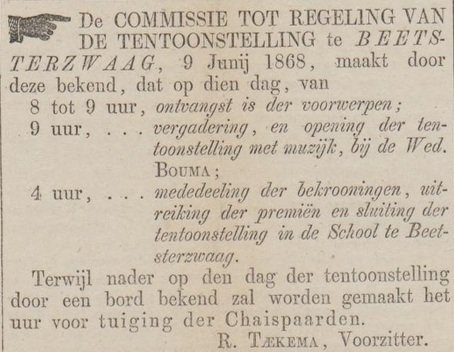
The program for the day was published in the newspaper, but it was also possible to obtain a program on the day itself from printer A. Plantinus in Drachten, which briefly outlined the times and locations of the festivities. Visitors could also purchase a catalog and a list of names of those who had submitted items for the exhibition. Transportation by horse and carriage from Drachten to Beetsterzwaag and back was arranged by D. Durksz. An admission ticket cost 25 cents, unless you were participating in the exhibition, were a caretaker, or were a member of the association or society, in which case it was free.
Course of the day
The day started at 8:00 a.m. with the reception of the objects to be exhibited. At 9:00 a.m. there was a meeting, followed by the opening with music at the home of Mrs. Bouma, who ran the De Klok inn during those years. There was also an open table on display there. The exhibition was held on her field. The exhibition itself was open from 10:00 a.m. to 4:00 p.m. Members of the 9th Division of the Frisian Agricultural Society, as well as tool makers and contributors of drawings who were not members of the society but lived in Smallingerland or Opsterland, were invited to submit entries and compete for the prizes.
At 4 p.m., the winners were announced and prizes awarded. This was followed by the closing ceremony at the school in Beetsterzwaag. During the day itself, a sign announced the times at which the harness horses would be harnessed, shown, and judged. The stallion Radboud and twelve of his offspring were also on display.
Requirements items
There were various categories of objects with which one could participate. Objects also included horses, cows, and other livestock. To participate in the exhibition, a freight-free declaration had to be submitted to the chairperson or one of the members of the department board. Everyone was responsible for their own items, and in the case of livestock, a good caretaker had to be present. It was mandatory to remain present until the end of the exhibition. The committee that judged everything consisted of the chairperson, secretary, and three members of the association. Those they considered the best, most effective, and worthy of the crown received a prize. Entrants were not allowed to compete for two prizes with the same item.
The prize money
Prizes that could be won for "chase horses, regardless of age or gender" were 25 guilders for first prize and 10 guilders for second prize. The horses were first inspected in hand and then in front of a two-wheeled carriage.
For cattle, a division by age was maintained. The best bull born in or before 1866 could earn a prize of 25 guilders, the best bull born in 1867 a prize of 20 guilders. There were also various classes of dairy cows, from heifers to 'guste-enterrieren'. The cash prizes ranged from 10 to 20 guilders. For a collection of eight cows consisting of two dairy cows, two twenter dairy cows, two enter dairy cows, and two heifers, one could win a first prize of 40 guilders. The condition was that the entire group of eight had to be owned by the same farmer and the dairy cows had to have calved in the spring of 1868. If the winners provided sufficient proof that the entire group had been raised in their own barn and from birth, the prize could be increased by a quarter.
Sheep were also exhibited. The prize money for the best sheep was slightly lower, at 7 guilders. Rams had to be in wool, while dairy sheep had to be out of wool. There was also a category for pigs: the best pig received 7 guilders as a prize.
Tools were also on display, such as an improved harness for two plow horses, collections of hay forks, manure forks, and grain forks, and a collection of small, practical, and useful hand tools. The best collection could win a prize of 3 guilders. There was also a category for 'Architectural drawings'. Plans could be submitted for a building for summer feeding, designed in such a way that the cattle were kept in stalls, accompanied by a description and explanation. A prize of 15 guilders was awarded for the best example. When assessing the drawings, attention was paid to the most efficient layout, the easiest feeding, the cost, the fact that cows could be kept clean without litter, and that the manure did not have to be taken outside every morning and evening. The drawings remained in the possession of the Society.
The supplementary program
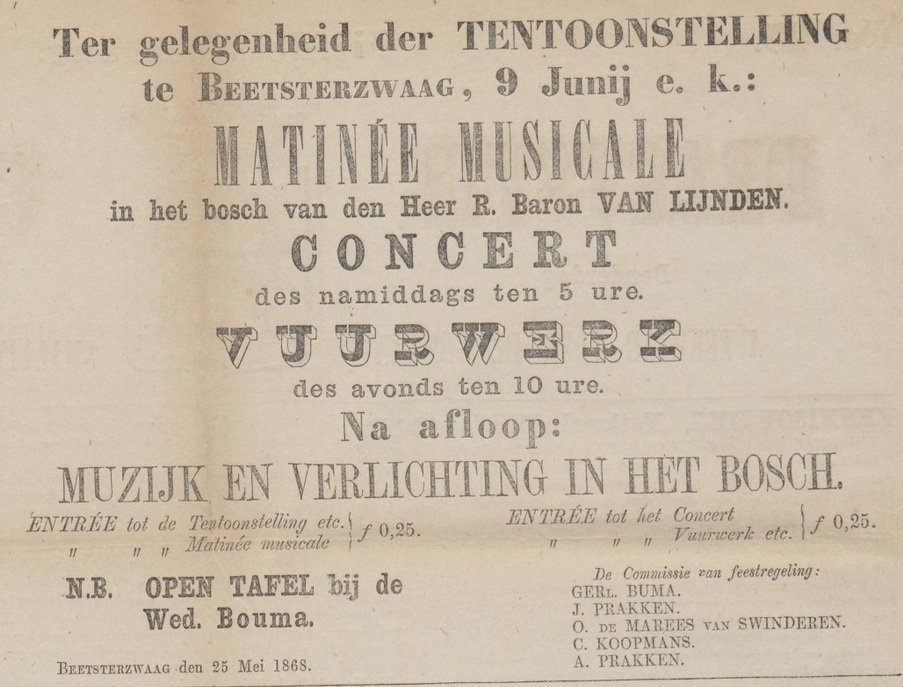
There was a real 'Party Planning Committee' in charge of the organization. Members of the committee were the Buma brothers, J. Prakken, registrar O. de Marees van Swinderen, C. Koopmans, and A. Prakken. Various side activities were linked to the exhibition to attract visitors: a variety of fireworks, music, and the opportunity to enjoy the wonderful outdoor air in Baron Van Lynden's forest would certainly contribute to this. The latter was something that could not be experienced at an exhibition in the city. There, people had to make do with stuffy and crowded lodgings. In Beetsterzwaag, visitors could enjoy the freshness and greenery of the surroundings.

Report of the day
Reports in the Leeuwarder Courant and Drachtster Courant newspapers show that the day was a great success. The weather was favorable and there were many animals and objects on display in the field. Horses, cattle, sheep, and pigs were well represented. Two 'beautiful, noble specimens' in particular attracted a lot of attention among the horses. The Association for the Improvement of the Horse Breed in Opsterland had entered its black-haired stallion Radboud among the objects on display. A 5-year-old chestnut-colored stallion with a white tail and mane, owned by H.B. Kielstra from Opeinde, also attracted much admiration. At the close of the exhibition, the chairman presented the prizes with an appropriate speech and words of thanks to the committees and special individuals.
Then the festivities began for lovers of music and natural beauty. A countless crowd made their way to the beautiful 'Beukenhiem' in the Lyndenbos, where a concert, a so-called 'Matinée Musicale', was given at 5 p.m. Under the direction of Mr. Schaub, music was performed by the Capel from Marburg in Keurhessen. The music echoed through the leafy avenues and many people also visited the famous thick tree. When dusk fell, balloons were lit. This Bengali fire created a very convivial atmosphere. At 10 p.m., the visitors left the forest to admire the fireworks. The finale, 'Tribute to the Frisian Society for Agriculture and Livestock', was illuminated by 'Greek fire' and concluded with cannon fire. Afterwards, many visitors returned to the forest to spend the rest of the evening there. All in all, it was a successful and well-attended day!